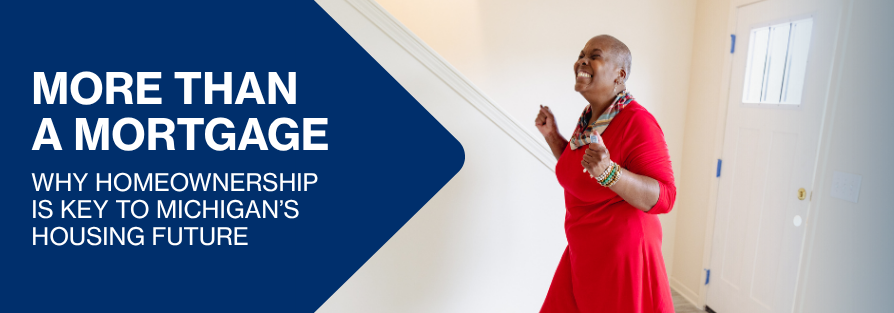
June is National Homeownership Month, and here in Michigan, there’s never been a more important time to talk about what it means to own a home, who has access to that opportunity, and why closing the gap matters for every community in our state.
Housing Is a Spectrum
When we talk about Michigan’s housing crisis, it’s easy to focus on a single point: rising rents, unaffordable home prices, or visible homelessness. But the reality is that housing is a spectrum, and families all across it are feeling the squeeze.
At one end, far too many Michiganders lack stable shelter entirely. Moving along the spectrum, many people are housed but living paycheck to paycheck, barely keeping up with rent. Others are steady renters who are financially ready for more stability but find homeownership perpetually out of reach, blocked by the need for a large down payment, credit barriers, or sale prices that simply don’t match their income. At the far end of the spectrum are homeowners who have built equity, stability, and a foundation for their families’ futures.
Every point on that spectrum matters. And pressure at one end creates ripple effects all the way through.
Michigan’s Housing Shortage Is Making Things Worse
Michigan is facing a housing shortage of somewhere between 150,000 and 200,000 units. That deficit doesn’t just mean fewer houses for sale; it drives up prices across the board. When supply can’t keep up with demand, both home sale prices and rental costs climb, pushing families further from the stability they need.
Renters who might otherwise be ready to buy stay in the rental market longer because ownership feels unattainable. That keeps rental vacancy rates low, which in turn keeps rents high for everyone else. It’s a bottleneck, and it runs the full length of the housing spectrum.
Where Habitat Fits In
Habitat for Humanity affiliates across Michigan work at a critical point in this spectrum: homeownership. We build and sell quality, affordable homes to families who are ready for ownership but blocked by common, solvable barriers: things like the lack of a down payment, sale prices beyond what modest incomes can support, or mortgage terms that don’t reflect a family’s actual ability to thrive.
By removing those barriers, we don’t just help one family. We help move the system.
When a family that has been renting transitions into homeownership, their rental unit opens up. More rental supply means less competition for units, which puts downward pressure on rents. It means other families (people who aren’t yet ready to own, or who are working through their own barriers) have a better shot at finding an affordable place to live. One family’s move up the spectrum creates breathing room for others behind them.
Building new homes also directly addresses the shortage. Every house Habitat builds is one more unit added to the total supply. It’s not a complete solution to a 150,000-to-200,000-unit deficit (no single organization can be), but it is a meaningful, lasting contribution.
What Homeownership Does for Families and Communities
The benefits of homeownership ripple far beyond a roof and four walls.
Stability and roots. Homeowners are less likely to move frequently, which means children stay in the same schools, families build lasting ties to their neighbors, and communities develop the cohesion that makes them resilient.
Community investment. When you own your home, you have a stake in what happens on your street, in your school district, in your city council. Research consistently shows that homeowners participate more in civic life: they vote more, volunteer more, and engage more actively in local decisions. That investment shows up in stronger neighborhoods.
Better outcomes for children. Studies show that children of homeowners have better educational outcomes on average: they’re more likely to graduate high school and attend college. They’re also more likely to have access to stable healthcare and are less exposed to the stressors associated with housing instability and frequent moves. The home a family owns today shapes the opportunities their children have tomorrow.
Wealth building. For most American families, home equity is the primary vehicle for building generational wealth. Renting, while essential and honorable, doesn’t build equity. Homeownership gives families an asset: something they can leverage, pass on, or fall back on in hard times.
Healthier homes, healthier families. Habitat homes are built to be safe, energy-efficient, and well-maintained. Families move out of overcrowded or substandard housing, and the physical and mental health benefits follow.
The Work Ahead
National Homeownership Month is a reminder of what’s possible, and a call to keep working toward it. The path to an affordable, stable home should not depend on the neighborhood you were born in or the family you came from. It should be a realistic goal for any family willing to put in the work.
Habitat Michigan and our affiliate network are committed to that goal. We build houses, yes. But more than that, we help build the conditions in which families, and the communities around them, can truly thrive.
If you’re interested in learning more about Habitat’s homeownership programs, or how you can support our work through volunteering, donating, or advocacy, click here to learn how you can get involved, or reach out to your local affiliate today.