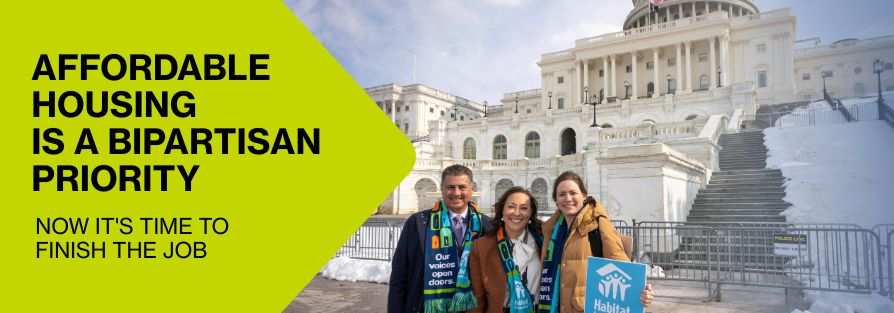
Affordable Housing Is a Bipartisan Priority. Now It’s Time to Finish the Job
Something rare is happening in Washington, D.C. and in Lansing. Lawmakers from both sides of the aisle are agreeing not just that America has a housing crisis, but that government has a responsibility to do something about it. In a political environment often defined by division, affordable housing has emerged as one of the few issues capable of building genuine bipartisan coalitions. The debate is no longer about whether something should be done. It’s about how quickly we can act together.
A National Housing Crisis Demands a National Response
The numbers are hard to ignore. Housing costs have surged across the country, driven by decades of underbuilding, restrictive zoning, rising construction costs, and a growing gap between wages and home prices. For low- and moderate-income families, the barriers to homeownership, and even to stable rental housing, have never been steeper. Millions of Americans are spending well beyond what they can afford just to keep a roof over their heads.
This crisis does not belong to one political party. It is felt in rural communities and urban centers, in red states and blue states, by renters and aspiring homeowners alike. And in 2025 and 2026, Congress has responded with something it has not produced in more than a decade: meaningful, bipartisan housing legislation.
Federal Momentum: Two Bills, One Direction
The Senate: The ROAD to Housing Act
In July 2025, the Senate Committee on Banking, Housing, and Urban Affairs did something it had not done in over a decade: it held a bipartisan housing markup and passed the result unanimously, 24 to 0. The bill, formally known as the Renewing Opportunity in the American Dream (ROAD) to Housing Act, was shepherded by Committee Chair Senator Tim Scott (R-SC) and Ranking Member Senator Elizabeth Warren (D-MA), and advanced to the full Senate as part of the National Defense Authorization Act, where it passed in October 2025.
The ROAD to Housing Act bundles together nearly 40 provisions drawn from dozens of previously introduced bills, the vast majority of which had bipartisan sponsorship. Its scope is sweeping, touching nearly every dimension of housing affordability, from supply and zoning to financing, repair, and environmental review.
Two provisions stand out as especially meaningful for Habitat affiliates and the families we serve. The Whole-Home Repairs Act (Section 204) creates a pilot program to fund critical home repairs for low-income homeowners, addressing health, safety, accessibility, energy efficiency, and resilience needs that can otherwise push families out of homes they’ve worked hard to own. And the HOME Investment Partnerships Reauthorization (Section 502) updates and strengthens the HOME program, one of the most vital sources of federal funding for affordable housing construction and rehabilitation across the country, and a cornerstone of how Habitat affiliates finance the work they do.
The bill also includes multiple provisions to streamline environmental review processes and reduce administrative burdens that slow housing production and drive up costs.
The House: The Housing for the 21st Century Act
On December 17, 2025, the House Financial Services Committee followed suit, passing the Housing for the 21st Century Act by a vote of 50 to 1, its first comprehensive, bipartisan housing markup in nearly a decade. On February 9, 2026, the full House passed the bill 390 to 9, an extraordinary show of bipartisan strength.
Like its Senate counterpart, the House bill incorporates provisions from more than 40 pieces of legislation, the majority of which were introduced with bipartisan support. Its priorities include modernizing the HOME program (Section 201), streamlining environmental reviews, and directing HUD to publish Housing Supply Frameworks: guidelines and best practices for state and local zoning and land use policies that would help communities reduce artificial barriers to building.
Together, these two bills represent a convergence of housing reform ambitions across both chambers and both parties that the country has not seen in a very long time.
Common Ground: Where the Two Bills Align
When both chambers agree on the direction, the path forward becomes clear, and these two packages agree on quite a lot.
Both the ROAD to Housing Act and the Housing for the 21st Century Act prioritize strengthening and modernizing the HOME Investment Partnerships Program, which is a bedrock tool for affordable housing development in Michigan and across the country. Both packages take meaningful steps to reduce regulatory barriers, including streamlining environmental reviews and coordinating federal oversight, that slow housing production and inflate costs. Both support the repair and preservation of existing homes, recognizing that keeping families in stable housing is just as important as building new units. And both encourage local zoning and land use reform through Housing Supply Frameworks provisions that give communities guidance and incentives to remove unnecessary restrictions on building.
This is not a case of two bills that overlap only superficially. There is deep, substantive alignment between these packages, and that alignment reflects years of work by housing advocates, researchers, and practitioners across the political spectrum who have been making the same arguments about what is needed.
Michigan Steps Up
The momentum is not limited to Washington. Just this month, right here in Michigan, a bipartisan group of state lawmakers unveiled a package of housing legislation led by Representative Joe Aragona (R-Clinton Township) and Representative Kristian Grant (D-Grand Rapids), colleagues from opposite sides of the aisle and opposite ends of the state who have been collaborating on this effort for over a year.
The Michigan package focuses on reducing zoning barriers and regulatory red tape that make it harder and more expensive to build new homes. Specific provisions include allowing duplexes in single-family residential zones, reducing minimum housing unit sizes, and lowering lot size requirements. These are all measures that can meaningfully increase the supply of housing that working families can actually afford. Representative Aragona put it plainly: if we want the next generation to be able to afford a home, we have to make it possible to build more of them.
From Washington to Lansing, leaders are recognizing that increasing housing supply and affordability requires cooperation – across party lines, across levels of government, and across the many stakeholders who have a role to play in solving this crisis.
Why This Matters to Habitat for Humanity of Michigan
For Habitat for Humanity of Michigan and our statewide network of affiliate organizations, these legislative developments are not abstract policy debates. They are directly connected to our ability to do our work.
Habitat affiliates across Michigan rely on HOME program funding and Community Development Block Grants (CDBG) to finance home construction and critical repair projects. When those programs are adequately funded, modernized, and easier to access, more homes get built. When they are underfunded or buried in unnecessary administrative complexity, families wait longer or never reach the finish line.
Home repair funding, like the Whole-Home Repairs pilot in the Senate bill, is especially important in Michigan communities where aging housing stock threatens the health and stability of families who are already homeowners. A leaking roof or failing furnace can undo years of hard-won progress. Preserving existing affordable homes is inseparable from the mission of expanding homeownership.
And when regulatory barriers are reduced, it directly lowers the cost of construction. For Habitat, that means more homes built, more families served, and a stronger foundation of long-term housing stability for communities across our state.
Policy reform translates directly into mission impact. Every provision that makes it easier to build, repair, and finance affordable homes is a provision that helps real Michigan families.
The Moment Ahead: Merge the Momentum
The work is not finished. The House and Senate have each passed their own bipartisan packages, and the two bills will now need to be reconciled into a single, unified piece of legislation before it can be signed into law. That process of reconciliation is where good legislation can stall, or where it can be strengthened by combining the best of what both chambers have produced.
We urge Congress to seize this moment. Combine the strongest provisions of both bills. Maintain an unwavering focus on increasing housing supply and reducing the barriers that stand between families and stable, affordable homes. And act with the urgency this crisis demands. Because for the families on Habitat waiting lists across Michigan, time matters.
Affordable housing is one of the few issues uniting leaders across the aisle, in both Washington and Lansing. The agreements are in place. The legislation exists. Now is the time to turn that agreement into action and action into homes.
Contact your Michigan state legislators. Encourage them to advance the bipartisan zoning reform package led by Representatives Aragona and Grant. Tell them that housing affordability is a priority for your family, your community, and the future of Michigan. Ask them to move the bills through committee and bring them to a vote.
The message is simple, and it crosses party lines: we need more homes, and we need them now. Affordable housing is not a partisan issue. It is a kitchen table issue; one that touches every family, every community, and every corner of our state.
Find your federal lawmakers: www.congress.gov/members/find-your-member
Find your Michigan state legislators: www.legislature.mi.gov
At Habitat for Humanity of Michigan, we build more than homes. We build stable futures. But we can’t do it alone. Join us in calling on leaders at every level of government to act boldly, act together, and get this done.