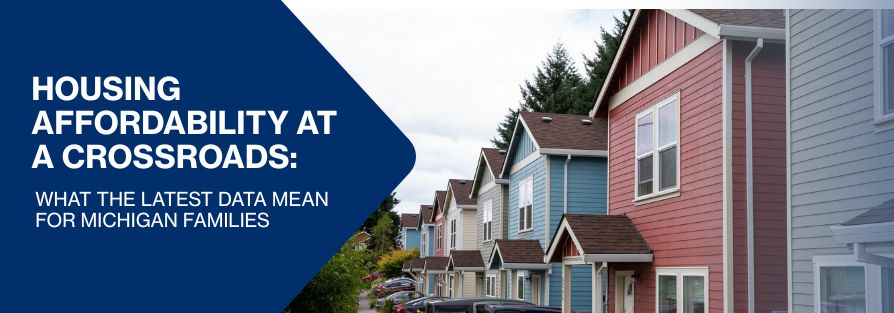
Housing Affordability at a Crossroads: What the Latest Data Mean for Michigan Families
Like many working parents, Sarah begins each morning by taking stock of her finances. She’s a certified nursing assistant at a Jackson hospital, earning $18 an hour. It’s good, steady work that keeps her community healthy. But after paying rent on her two-bedroom apartment, she has just enough left to cover utilities, groceries, and her daughter’s school supplies and activities. Saving for a down payment on a home? That feels like a dream reserved for someone else’s life.
Sarah’s story isn’t unique. Across Michigan and the nation, working families are stretched impossibly thin by housing costs that have reached crisis levels. According to the Joint Center for Housing Studies at Harvard University, housing cost burdens hit record highs in 2024, with nearly one-third of all U.S. households now spending more than they can afford just to keep a roof over their heads.[1] What was once considered a pathway to stability – having a job, paying your bills, working toward homeownership – has become a precarious balancing act for millions of American families.
What “Housing Cost Burden” Really Means
Housing experts use a simple but powerful benchmark to measure affordability: households spending more than 30% of their income on housing costs are considered “cost-burdened.” When that figure climbs above 50%, they’re “severely cost-burdened.”
These aren’t just statistics. They represent real trade-offs families make every day. The Harvard Joint Center for Housing Studies found that cost-burdened households have significantly less money available for other essentials like nutritious food, healthcare, transportation, and emergency savings.[1] For families on the edge, an unexpected car repair or medical bill can trigger a cascade of impossible choices.
Nationally, the picture is sobering. Nearly one in three U.S. households are cost-burdened, with renters facing the most acute pressures, many paying more than half their income just for rent and utilities.[1]
Michigan’s Housing Affordability Reality
Cost Burden in Michigan
Michigan fares slightly better than the national average, but the challenges remain significant. Approximately 28% of Michigan households spend more than 30% of their income on housing costs.[2] While this sits below the national rate, it still represents hundreds of thousands of families struggling to balance housing expenses with other basic needs.
The burden affects both renters and homeowners. Rising property taxes, insurance premiums, and maintenance costs mean that even families who’ve achieved homeownership aren’t immune to affordability pressures.
Who Is Most Affected?
Renters face the steepest challenges. According to the National Low Income Housing Coalition, a worker in Michigan needs to earn approximately $24.23 per hour, working full-time, to afford a modest two-bedroom rental at fair market rent.[3] That’s more than three times Michigan’s minimum wage of $10.33 per hour and significantly higher than what many essential workers earn.
Consider the math: A full-time worker earning $15 per hour earns roughly $2,600 monthly before taxes. To be cost-burden free, their housing costs should stay under $780. But the average two-bedroom apartment in Michigan rents for well over $1,200 monthly, immediately pushing working families into cost-burdened territory.[3]
Homeownership doesn’t automatically solve the affordability puzzle, either. Beyond the mortgage payment, homeowners face what experts call the “hidden costs” of homeownership: property taxes, insurance (which has spiked dramatically in recent years), maintenance, repairs, and utilities. According to recent estimates, these costs can add $15,000 or more annually to the true cost of owning a home.[4]
What the Data Mean for Aspiring Homeowners
For Michigan families dreaming of homeownership, today’s market presents multiple barriers:
Supply constraints remain a fundamental challenge. While Michigan has seen new construction activity, the state still faces a significant shortage of affordable housing units. The gap between supply and demand keeps prices elevated, particularly for starter homes that first-time buyers need.
The affordability gap continues to widen. Home values in many Michigan communities have risen faster than incomes, meaning families who could have afforded to buy just a few years ago now find themselves priced out. According to Harvard’s housing research, this squeeze affects moderate-income households particularly hard. Families earning too much to qualify for traditional housing assistance but not enough to comfortably afford market-rate housing.[1]
Down payment barriers keep homeownership out of reach even for families who could manage monthly mortgage payments. With home prices higher and traditional down payments often requiring 10-20% of the purchase price, saving tens of thousands of dollars while paying high rent creates an impossible catch-22. Families without generational wealth to draw from face the steepest climb.
How Habitat for Humanity of Michigan Is Part of the Solution
At Habitat for Humanity of Michigan, we see these challenges as a call to action. For more than three decades, we’ve been working alongside families like Sarah’s, creating pathways to affordable homeownership and community stability.
Creating Affordable Ownership Opportunities
Habitat builds and rehabilitates homes that families can actually afford to buy. Through our unique model, which combines donated materials, volunteer labor, and zero-interest mortgages, we keep home prices within reach for working families. Homeowners don’t just get a house; they build equity, gain stability, and invest in their children’s futures. Each home built by Habitat is a direct response to the affordability crisis documented in the latest housing data.
Financial Education and Support
We know that sustainable homeownership requires more than just an affordable mortgage. That’s why Habitat Michigan provides comprehensive financial education, credit counseling, and homebuyer preparation programs. We work with families to build savings, improve credit scores, and develop the skills needed to maintain a home for the long term. Our approach addresses both the immediate affordability crisis and the long-term wealth-building potential of homeownership.
Policy and Cross-Sector Partnerships
Michigan has ambitious housing goals, including plans to preserve and create tens of thousands of affordable housing units across the state. Habitat Michigan actively engages with local leaders, policymakers, and community partners to advocate for policies that expand affordability. We work alongside developers, nonprofits, and government agencies because we know that solving the housing crisis requires collaboration across sectors and sustained commitment from the entire community.
Building Toward a More Affordable Future
The latest data on housing affordability paint a challenging picture for Michigan families. But they also illuminate a path forward. When Sarah eventually moves into her Habitat home, it won’t be because the market magically fixed itself. It will be because people chose to act.
Every volunteer who picks up a hammer, every donor who invests in affordable housing, every community leader who prioritizes housing policy, and every partner organization that joins the effort contributes to closing the affordability gap one family at a time.
Ready to be part of the solution? Learn more about Habitat for Humanity of Michigan’s programs and ways to support affordable housing in your community at habitatmichigan.org. Together, we can ensure that working families across Michigan have a solid, affordable foundation on which to build their dreams.
[1]: Joint Center for Housing Studies of Harvard University. (2024). The State of the Nation’s Housing 2024. Harvard University. https://www.jchs.harvard.edu/state-nations-housing-2024
[2]: U.S. Census Bureau. (2023). American Community Survey 5-Year Estimates, 2018-2022. Table B25106: Tenure by Housing Costs as a Percentage of Household Income. https://data.census.gov
[3]: National Low Income Housing Coalition. (2024). Out of Reach 2024: Michigan. https://nlihc.org/oor/state/mi
[4]: Zillow Research. (2024). The Hidden Costs of Homeownership. https://www.zillow.com/research/