
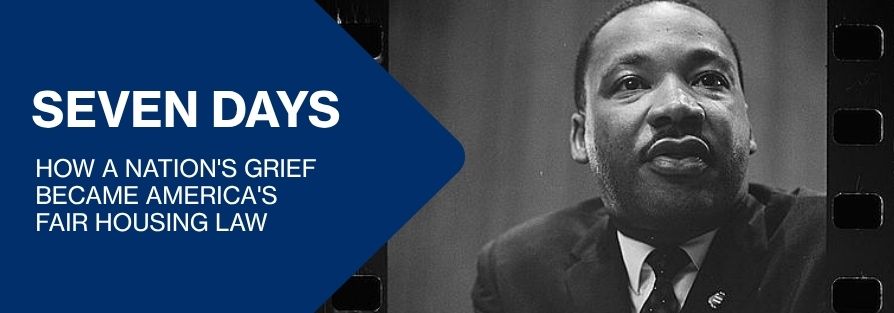
Seven Days: How a Nation’s Grief Became America’s Fair Housing Law
Every April, we mark Fair Housing Month. But the story of how April came to matter in housing policy begins not with legislation, but with a loss.
April 4, 1968
Dr. Martin Luther King, Jr. was assassinated outside Room 306 of the Lorraine Motel in Memphis, Tennessee. He was there to support striking sanitation workers — Black men who earned poverty wages and were denied the basic dignity of equal treatment on the job.
Within hours, grief ignited cities across the country. Riots erupted in more than 100 communities. Smoke from burning neighborhoods drifted over the dome of the U.S. Capitol in Washington.
Seven days later, on April 11, 1968, President Lyndon B. Johnson signed the Fair Housing Act into law.
Seven days.
That urgency, born from tragedy, from moral reckoning, from a nation confronting what it had allowed to happen, is part of what makes April so significant for those of us who work in affordable housing. Fair Housing Month isn’t an administrative observance. It’s a memorial. And it carries an obligation.
The Bill That Couldn’t Pass… Until It Had To
The Fair Housing Act didn’t emerge overnight. Civil rights advocates had been pushing for open housing legislation since early in the twentieth century, but it wasn’t until after World War II that serious efforts took hold. Even then, progress was agonizingly slow.
The bill was the subject of contentious debate, intended as a follow-up to the Civil Rights Act of 1964, and had been stalled for years. A proposed Civil Rights Act of 1966 had collapsed entirely because of its fair housing provision. The legislation was described by supporters as civil rights “getting personal.” Not about changing behavior in the South, but about challenging discrimination in neighborhoods everywhere, in every state.
The bill had passed the House in August 1967 and made it through the Senate with amendments on March 11, 1968. But it then entered a legislative limbo as the House Rules Committee, which had long acted as a brake on civil rights initiatives, postponed action on the amended bill.
Prospects for the legislation seemed bleak when the House adjourned on the afternoon of Thursday, April 4. A few hours later, Martin Luther King was assassinated, and the nation’s mood changed dramatically as riots broke out in cities throughout the country. Some 21 House Republicans immediately broke party ranks and urged passage of the Senate bill.
In this moment of national crisis, President Johnson implored Congress to act, framing the passage of the Fair Housing Act as the most fitting tribute to Dr. King’s legacy. The urgency of the moment broke the political logjam. As troops responding to the unrest still ringed the U.S. Capitol, the House of Representatives gave final congressional approval to a bill designed to end discrimination in 80 percent of the nation’s housing.
It passed. Not because hearts had changed. Because history demanded it.
What the Law Actually Did
The Fair Housing Act made it unlawful to refuse to sell, rent to, or negotiate with any person because of their inclusion in a protected class. Its goal was a unitary housing market in which a person’s background, as opposed to their financial resources, would not arbitrarily restrict access to housing.
The original law prohibited discrimination based on race, color, religion, and national origin. Discrimination on the basis of sex was added in 1974, and people with disabilities and families with children were added to the list of protected classes in 1988.
The law also prohibited more than outright refusal to sell or rent. It covered discrimination in the terms and conditions of a sale or rental, discriminatory advertising, and interference with a person’s fair housing rights. It was comprehensive in scope and in intent.
King himself had been a driving force behind the legislation. From 1965 to 1966, Dr. King co-led the Chicago Freedom Movement, a campaign that sought to challenge discrimination in employment, education, and housing. He had seen firsthand how housing discrimination was not just a Southern problem, it was a national one, embedded in policy, practice, and culture across every region of the country.
The Fair Housing Act was, as historians have called it, the final great legislative achievement of the civil rights era.
The Gap Between the Law and the Legacy
Passing the law was the beginning, not the end.
Long before the Fair Housing Act existed, the federal government had actively built a segregated America. Beginning in the 1930s, the Home Owners’ Loan Corporation (HOLC) created color-coded maps that rated the “mortgage risk” of neighborhoods in cities across the country. Neighborhoods with Black residents, regardless of income, housing quality, or community stability, were systematically rated “hazardous” and shaded in red. This practice became known as redlining.
The federal government redlined 11 Michigan cities, including Battle Creek, Bay City, Detroit, Flint, Grand Rapids, Jackson, Kalamazoo, Lansing, Pontiac, Muskegon, and Saginaw, as well as many of their adjacent suburban municipalities.
The consequences were not abstract. While mortgage credit flowed to white families, allowing them to purchase new homes and build equity, families living in redlined areas were denied the same opportunity. People of color could not purchase properties in the newly developed suburbs, nor did they have sufficient access to credit to reinvest in their neighborhoods.
Those patterns did not disappear when the Fair Housing Act was signed. The policies locked in housing patterns and fostered the decades-long white flight that came to define regions like Detroit, establishing patterns that cannot be “undone” in a generation or two.
The data makes this painfully clear right here in Michigan. A 2024 Michigan Statewide Housing Needs Assessment revealed a 34-percentage-point homeownership gap between Black and white households, underscoring the lasting impact of U.S. housing policies like redlining, which imposed racialized segregation in the housing market.
Detroit ranks as the fourth-most segregated metro area in the nation, and Michigan cities such as Grand Rapids and Battle Creek have some of the highest rates of housing segregation in the country.
The law changed. The landscape — physical, financial, and demographic — did not change nearly enough.
The Work That Continues
This is where organizations like Habitat for Humanity of Michigan enter the story.
We are not a civil rights organization in the traditional sense. But the work of building affordable homes — of helping families access stable, safe housing and the wealth-building that comes with it — is inseparable from the legacy of fair housing. Every family we serve who has been locked out of homeownership by income, by credit history shaped by systemic barriers, by the geography of opportunity in Michigan’s communities, is living in the long shadow of the history described above.
The Fair Housing Act gave America a legal framework for justice. Habitat Michigan works to make that framework real. One home, one family, one community at a time.
This April, as we mark the 57th anniversary of the Fair Housing Act, we honor the law and the man whose death catalyzed its passage. And we recommit to the work that the law alone was never going to finish.
The seven days between April 4 and April 11, 1968, changed what was legally possible in this country. What we do with that possibility. That’s up to us.