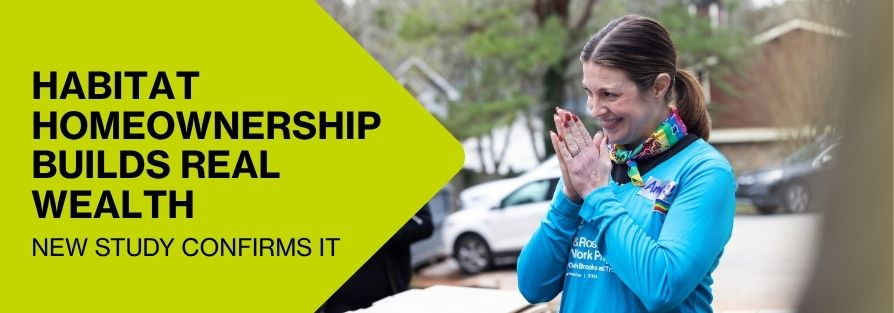
At Habitat for Humanity of Michigan, we’ve always believed that homeownership is one of the most powerful pathways out of poverty. Now, a major new study from Habitat for Humanity International and Washington University in St. Louis puts hard numbers behind that belief.
The report, Wealth Building and Financial Health of Habitat Homeowners, compares Habitat homeowners to non-Habitat homeowners and low-income renters using survey data, interviews, and credit bureau data from Equifax. The findings are striking, and they reinforce why the work we do together matters.
What the Research Found
Habitat homeowners are dramatically more protected from foreclosure. Even when a Habitat homeowner misses a mortgage payment, they are 56% less likely to lose their home to foreclosure than similar neighbors. When affiliates service mortgages in-house, that protection is even greater.
Credit scores rise, and keep rising. On average, Habitat homeowners see their credit scores increase by 22 points compared to their neighbors. The gains start before the purchase, driven by Habitat’s pre-purchase education and counseling, and compound over time. By the eighth year of homeownership, credit scores are up 43 points on average.
Savings grow meaningfully. Habitat homeowners accumulate an average of $1,800 more in liquid assets than comparable neighbors, a gap that widens to $4,400 by the sixth year. For Black homeowners, the impact is even more pronounced: $3,100 more on average, and nearly $8,000 more by year six.
Affordable mortgages build equity fast. Habitat’s zero- and low-interest mortgage model enables equity to grow from day one, often reaching 2.6 times the purchase value over a 30-year period. Tools like forgivable loans and shared appreciation mortgages amplify early returns while preserving long-term wealth outcomes.
Homeowners report greater confidence and optimism. Habitat homeowners describe gaining financial confidence over time and actively saving for the future, especially with ongoing support from their affiliate. They also report significantly higher satisfaction with their home, their life, and their outlook for the future compared to similar non-Habitat households.
The goal is intergenerational. When homeowners talk about building wealth, they talk about their children, about breaking cycles of instability and leaving something behind for the next generation.
Why This Matters for Michigan Families
These findings reflect what we hear from homeowners here in Michigan every day. Homeownership isn’t just about having a place to live, it’s about stability, dignity, and the chance to build a future. This research confirms that Habitat’s model works, and that the ripple effects extend well beyond the front door.